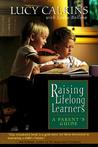
 Raising Lifelong Learners: A Parent's Guide by Lucy McCormick Calkins
My rating: 4 of 5 stars
My children's ages now range from 16 to 29 so you may wonder why on earth I would choose to read a book such as this. Perhaps I think of myself as a "lifelong learner". Perhaps I hope that something I did while raising my six daughters made of them "lifelong learners". I found the thoughts of the author to be very refreshing, sensible, and what is more--backed up with findings of many research studies and personal experience.
While the author was not a home-educator, nor does she mention home-education even once, her very readable suggestions offer gentle guidance to any parent, no matter what the educational preferences for their children may be.
She begins with infancy, working on to early education and then includes the middle childhood years. She addresses all the subject matter. Her chapters progress from "talk--the foundation of literacy" to "reading aloud--an apprenticeship in the literate life" to "early writing" and "early reading". She includes a wonderful chapter on "playing well". She fleshes out "helping children develop good work habits: hobbies, projects, chores, and the lessons they teach". "Reading" and "writing" in the "middle childhood years" follow. Then she walks us through math, science, and social studies.
This six appendixes written by her co-author are for the parents who are invested in public education. This section includes pro's and con's, legal rights and concerns, and selection of programs and how to have influence in district offerings.
After posting my review of this book I skimmed the reviews of others. One person said any parent with common sense would follow this course, and therefore he was disappointed. I think he mistakes "common sense" for "scripting". I must have somehow been scripted with this vein of common sense, as her suggestions were what I instinctively used. I am very grateful for the influences which my parents had in my life and their parents in theirs and so forth. Parents experience so much stress when it comes to education and their children -- they want their children to have the best possible launch in life. Often, when we act upon these fears and whatever methods that are trending the result is that families are held hostage through rigidly following workbooks, programs, and incessantly hammering away at the "ought to's". Which is precisely why this book is so important and has so much to offer.
 101 Things You Should Do Before Your Kids Leave Home by David Bordon
My rating: 4 of 5 stars
Whatever you plan to "put into" your kids, you'd better have it done by age 14. I loved the notion of making a bucket list, as it were. The "scrapbooking mom" in me would then create a page for each one and document them with photos and journaling as we ticked them off. Each of the suggestions in this book is fleshed out with a page of narration--the whys and hows and possibilities.
My children are mostly grown now, so what we would do with something like this is look back and create our own journey, calling it something like "Mom's Rules of the Universe: A Guide for Scripting Ourselves and Our Families".
I tagged 60 of the 101 ideas to talk about with my family. Anyone at a loss of what to do on "Monday Family Night" would do well to consult this little tome for inspiration.
Here's a sample suggestion from the book...
#50 FIND A CHURCH AND STICK TO IT (p.100)
"Church families are as dysfunctional as any other. But they're also the place where you and your children learn to deal with problems, to grow, and to forgive. "Getting along" skills grow at church.
There are many different types of churchgoers. You have the only-on-Christmas-and-Easter crowd and the whenever-the-building's-open crew, and those who don't go anymore. The latter group sees church as a machine of abrasive parts and squeaking gears. But they may be missing the big picture. True church is a place of excitement where like minds gather for a greater purpose.
...
Once you've found a church and feel settled, support your pastor and fellow believers. Otherwise you and your children will forever feel like outsiders and never learn the value of commitment.
Being faithful to your church is a way of showing unconditional love to flawed people. Show your kids it's okay to settle for the off-key earthly choir and a congregation full of people trying, but not quite there yet. Standing back in judgment isn't the answer--never has been. Only by joining in will you see discord disappear, joys heightened, and get a small sliver of your heavenly home."
I liked this so much I bought a copy after reading it.
 The Home-Maker by Dorothy Canfield Fisher
My rating: 4 of 5 stars
Best known for her children's novel, "Understood Betsy", and also for her non-fiction works such as "Montessori Mother", Fisher wrote many novels for adults, including this one first published in 1924, in which she fleshes out her insights and philosophy while digging at the roots of some of our most deeply held prejudices.
The work, as a whole, prompted me to examine my own experiences and philosophies as a wife, mother, and creative individual.
I won't attempt to introduce characters or summarize plot. I will nail down a dozen passages. These may have the effect of "spoilers", so proceed with that risk in mind.
p.76 (vocabulary: "Gehenna") "In Jewish, Christian and Islamic scripture, Gehenna is a destination of the wicked." -- Wikipedia
Mrs. Prouty ...was looking at a $200 fur coat as tragically as though it were the Pearly Gates and she sinking to Gehenna.
p.176 She never made the slightest effort of her own accord to escape from the rubber-stamp formula in which she had been brought up. By lively joshing you could occasionally jolt her into a spontaneous perception of her own, but the minute you stopped, back she sank and pulled the cover of the Ladies' Guild mummy-case over her.
p.178 "Do you know what you are saying to me? You are telling me that you really think that home-making is a poor, mean, cheap job beneath the dignity of anybody who can do anything else." --Lester Knapp
"How dare you say such a thing! I never dreamed of having such an awful idea." --Mattie Farnham
p.179 She brought out a formula again, but this time with heartfelt personal conviction. "Home-making is the noblest work anybody can do!"
p.180 "Don't go looking to see if the furniture is dusted or the floor polished," said Lester calmly. "We concentrate on the important things in our house and let the non-essentials go."
p.182 Stephen had squatted down again to his sand. She went cautiously towards the wide plank to see what he was doing, prepared to have him snarl out one of his hateful catch-words: "Go 'way!" or the one he had acquired lately, the insolent, "Who's doing this anyhow?"
But what she saw was so astonishing to her that before she could stop to think, she burst out in an impulsive exclamation of admiration, "Why, Stephen Knapp, did you do all that yourself?"
Beyond the board lay a tiny fairy-world of small tree-lined, pebble-paved roads, moss-covered hills, small looking-glass lakes, white pasteboard farmhouses with green blinds, surrounded by neat white tooth-pick fences, broad meadows with red-and-white paper cows and a tiny farm wagon with minute, plumped-out sacks, driving to the railroad.
p.189-190 ... it was easier to talk about things you cared awfully about when you were working together. Helen often wondered why this was, why she didn't feel so shy when she was doing something with her hands, buttering a cake-tin, or cutting animal-shaped cookies...
p.192 One day, as she washed the breakfast dishes for Father to wipe, she noticed how the daffodils ... were reflected in a wet milk-pan. It made her think a poem, which she said over in her head to make sure it was all right, and then repeated to Father, "The shining tin usefulness of the milk-pan Is glorified into beauty By the presence of a flower."
...She had secretly a high opinion of her own talents. Why had she said it aloud except to make Father think what a remarkable child she was? She washed the dishes thoughtfully, feeling a gnawing discomfort. It was horrid of her to have said that just to make Father admire her. It was showing off. She hated people who showed off. She decided ascetically to punish herself by owning up to her conceit. "I only told that poem to you because I thought it would make you think what a poetic child I am," she confessed contritely. "It wasn't really that I thought so much about the flower."
p.193 She felt better. There now! Father would think what an honest, sincere child she was!
Oh, dear! That was showing off too! As bad as the first time! She said hastily, "And I only owned up because I thought it would make you think I'm honest and didn't want to show off!"
This sort of tortuous winding was very familiar to Helen. She frequently got herself into it and never knew how to get out. It always frightened her a little, made her lose her head. She felt startled now. "Why, Father, do you suppose I only said THAT, too, to make you..." She lifted her dripping hands out of the dishwater and turned wide, frightened eyes on her father. "Oh, Father, there I go! Do YOU ever get going like that? One idea hitched to another and another and another; and you keep grabbing at them and can't get hold of one tight enough to hold it still?"
Lester laughed ruefully. "DO I? Nothing but!..."
p.253 It was abominable to be poor! It brought out the worst in every one. When you were distracted with worry about money, you simply weren't yourself.
p.258 Poverty...isolation, monotony, stagnation, killing depression over never-ending servile tasks...POVERTY!
p.273-274 He thought of the long hours during which he bent his utmost attention on the children to understand them, to see what kind of children they were, to think what they needed most now--not little passing pleasures such as good nature and indulgence would suggest, but real food for what was deepest in them. He thought of how he used his close hourly contact with them as a means of looking into their minds and hearts; how he used the work-in-common with them as a scientist conducts an experiment station to accumulate data as material for his intelligence to arrange in order, so that his decisions might be just and far-sighted as well as loving. He thought how in the blessed mental leisure which comes with small mechanical tasks he pored over this data, considered it and reconsidered in the light of some newer evidence--where was now a good-natured young hired girl, let her be ever so indulgent and gentle? "You can't HIRE somebody to be a parent for your children!" he thought again, passionately.
p.276 Over his head Tradition swung a bludgeon he knew he could not parry.
p.278 Why, the fanatic feminists were right, after all. Under its greasy camouflage of chivalry, society is really based on a contempt for women's work in the home. The only women who were paid, either in human respect or in money, were women who gave up their traditional job of creating harmony out of human relationships and did something really useful, bought or sold or created material objects.
 The Mother at Home by John S C Abbott
My rating: 3 of 5 stars
What would you expect from a parenting book penned by a pastor born 200 years ago? If I hadn't read a rave review from someone who included a disclaimer that some of the discipline techniques touted in the preface would have put her off I too would have shut the book and gone no further. However, I found it to be filled with good principles and solid suggestions.
Today's reader will have to do some mental editing to adjust the author's recommendations to what is now known about child development. The author directs his remarks to those who are of a Judeo-Christian persuasion. I found many of his points to be instructive even now. All my children are raised, making the reading of this book a reflective examination of my own motherhood journey.
The writer proceeds with bullet points and then fleshes them out with chatty examples so his meaning does not escape the reader. Looking at the bullets alone strips the work down to the bone, thus losing the charm of the work. I make the following notes to jog my memory and to pair with the quotes I have collected from the book.
I. Obedience is absolutely essential to proper family government (p.18)
II. How is this habit of obedience to be established? (p.22)
1. Never give a command which you do not intend shall be obeyed.(p22)
2. Never punish when the child has not intentionally done wrong.(p49)
3. Never think that your child is too young to obey.(p55)
4. Guard against too much severity.(p.57)
Chapter IV - The Mother's Difficulties
1. One great obstacle is the want of self-control on the part of parents.(p61)
2. Another great obstacle in the way is the want of resolution.(p64)
3. Another great obstacle in the way of training up a happy and virtuous family is the occasional want of harmony between parents on the subject of education.(p75)
Chapter V - Faults and Errors
1. Do not talk about children in their presence.(p83)
2. Do not make exhibitions of your children's attainments.(p88)
3. Do not deceive children.(p97)
4. Do not be continually finding fault.(p100)
5. Never punish by exciting imaginary fears.(p107)
Chapter VI - Religious Instruction
1. Children must be taught religious truth at home.(p113)
2. Parents must have deep devotional feelings themselves.(p115)
3. Present religion in a cheerful aspect.(p119)
4. Improve appropriate occasions.(p121)
5. Avoid inappropriate occasions.(p133)
Chapter VII - Religious Instruction -cont.-
1. It is our privilege and our duty to describe heaven to our children as God has described it to us.(p138)
2. Dwell particularly upon the Saviour.(p142)
3. Pray with your children.(p146)
4. Teach your children to pray themselves.(p151)
5. Expect that your child will become a Christian.(p155)
6. Do not speak to others of the piety of your child.(p158)
Chapter VIII - Results
1. Mothers have as powerful an influence over the welfare of future generations as all other causes combined.(p165)
2. There is certainly much that fathers can do, but this treatise is prepared to impress upon the mind the duties of mothers.(p167)
3. Nothing can be of greater importance to the parents and child than a correct system of family government.(p171)
4. Keeping a journal of observations about your child will help the mother determine a course of action.(p173)
a. The habit of keeping such a record indces a mother to look with greater scrutiny into her own motives of action, into her principles of family government, and to govern her own heart and conduct, and cultivate more of a spirit which every mother needs,--a spirit of prayer.(p177)
b. The plan I would suggest might be something like the following.
1. Notice the earliest developements of temper.
2. Remark what things peculiarly interest your child.
3. Describe the course pursued to insure obedience.
4. Describe the course of first religious instruction and what generally excites the strongest interest in your child's mind.
 Dad Time: Savoring the God-Given Moments of Fatherhood by Max Lucado
My rating: 3 of 5 stars
What a treat it was to read a few passages every morning and night. This is a compilation from 36 of the author's books of articles that focus on being a father, many of which also point to the love of Christ and God for us and their workings in our lives. Some of the articles were taken from unpublished sermons he has given.
My only regret is there is no table of contents. It would be good to own a copy of this to pull out and read on occasion.
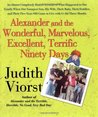 Alexander and the Wonderful, Marvelous, Excellent, Terrific Ninety Days: An Almost Completely Honest Account of What Happened to Our Family When Our Youngest Son, His Wife, Their Baby, Their Toddler, and Their Five-Year-Old Came to Live with Us for Thr... by Judith Viorst
My rating: 3 of 5 stars
Written by a grandparent for grandparents, it's the sort of book you pack around in your bag for those odd minutes you find yourself waiting -- in the car, at an appointment, for a timer beep.
The author shares the plans, process, and recovery of a family (which includes a son, daughter-in-law, baby, toddler, and six year old) sharing her home for three months.
I am very different from her so would not share many of her issues. However, I found some value in seeing a different approach than I would make. Her wrap-up chapters where she has interviewed others do look at a variety of styles.
I wondered if the author was more like my paternal grandmother. I could appreciate her in a different (better?) way having read this account.
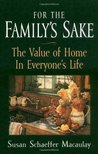 For the Family's Sake by Susan Schaeffer Macaulay
My rating: 4 of 5 stars
The author and I could be "kindred spirits". She offers much comforting, encouraging, and practical advice about creating a rich family life -- no matter if one is single, newlywed, raising children, or past that.
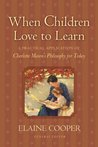 When Children Love to Learn: A Practical Application of Charlotte Mason's Philosophy for Today by Elaine Cooper
My rating: 4 of 5 stars
Anyone who shares an interest in educational philosophy will at some point need to look at Charlotte Mason, an educator during the Victorian era whose vision lives on in today's learning landscape. This volume makes her work accessible through the editor's forward and instructive essays by educators well versed in her methods.
Having attended several Mason workshops during the years I was raising my children I found her methods to be very duplicatable and effective. So it was with interest I read her objections to German philosopher Johann Herbart's theory (on pages 118 and 119 of this work). I think I was squarely in his camp, so to speak, and all my self-perceived successes were actually failures and all my self-perceived failures were successes (regarding my children's educations).
"...His theory of learning revolves around the thought that the child has no personality in the sense that Miss Mason described or believed, that ideas contend to find entrance into the threshold of the child's mind, and that once in, these ideas form themselves in related groups called apperception masses. It becomes the role of the teacher to arrange appropriate ideas within the curriculum, to make the best relations between ideas so that cognitive connections may be facilitated. It is like the arranging of mental furniture in the mind's household, with the teacher playing the part of interior decorator. In this model the teacher is the active player, choosing the ideas, arranging the correlations, planning out every contingency. The child becomes a new creation as he comes forth from the hands of the teacher. These well-planned units of instruction were called concentrations schemes.
One such plan was designed around Robinson Crusoe. It was here that the plans of a teacher-centered effort came forth: The whole unit was systematized, arranged, and packaged for the child's consumption, for consumer he is, in Herbart's way of thinking. As these elementary-aged students read a child's adaptation of the original classic work, they were provided with integrating experiences that connect art, handicrafts, writing, recitation, and arithmetic. Students drew Crusoe's island, wrote about his experiences, counted wine casks, and built models. In these tasks Miss Mason noted seeds of inanity, as she believed the content to be trivial indeed. The same might be said of units centered on themes such as apples or teddy bears, topics that find their way into many classrooms. Her word for this would be twaddle, and an answer to the concentration scheme approach is as follows:
As I have said elsewhere, the ideas required for sustenance
of children are to be found mainly in books of literary quality;
given these the mind does for itself the sorting, arranging,
selecting, rejecting, classifying, which Herbart leaves to the
struggle of the promiscuous [indiscriminate] ideas which manage
to cross the threshold. Mason, HOME EDUCATION, 315. "
However, having said all that, I am complete agreement with the following observations made under the heading "A Curriculum Scope" found on page 213:
"Looking at what is to be taught throughout the years of schooling can be an overwhelming task at times as we see examples of delayed and accelerated learning. These are two extremes to avoid. The attitude of not introducing a discipline of study until children show an interest allows children to limit themselves according to what they know, as well as to acquire a debilitating habit of acting according to feelings. By contrast, the accelerated approach looks at learning in the realm of conquest rather than as a natural affinity in relationship with the world."
The team that created this book have also established a school (1999) which is called Ambleside. More information can be found here: https://www.amblesideonline.org/ .

No comments:
Post a Comment