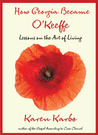
 How Georgia Became O'Keeffe: Lessons on the Art of Living by Karen Karbo
My rating: 4 of 5 stars
Whoever thought that reading a biography could be such PuredeeLight?!! Okay, for those of us with Insatiable Curiosity (bordering on the Kipling 'Elephant's Child' kind), ALL biographies portend to be entertaining in some way. I'm dubbing Karbo the 'Dave Barry' of biography and now am scrambling to find all of her books,or at the very least, all her "kick-ass women" trilogy (as she calls them) to devour (metaphorically speaking, of course).
I confess, I'm one of those who savors EVERY aspect of a book. Silly, but I love the SIZE of this book (7.6 x 5.6), the weight of the paper, the fonts used, the use of colored type indicating the chapter segments, the full color images of one of Okeeffe's works at the beginning of each chapter (how to choose from the 2,045 of her lifetime output?), and all the delightful footnotes (many of which were no more than parenthetical remarks). Reading this book was akin to having a chat over lunch with the author, at once exploring and celebrating a most remarkable life and musing about our own lives and choices. Delectable.
Having said all that, I'm not sure that this book would strike the same chord with other women I know and respect. There is the occasional descriptively-used expletive, which neatly drives home the author's observations. It's a quick read about a voluminous life. The book is more of a 'whet-the-appetite' than a 'full-course-dinner' about the subject of the work. There is plenty written about Georgia O'Keeffe and Karbo includes this link to a full bibliography: www.okeeffemuseum.org . In addition, she shares her personal favorites in her Acknowledgments.
 God's Smuggler by Brother Andrew
My rating: 5 of 5 stars
There is so much to learn of faith in this account of one man's commitment to his faith in Jesus Christ. (hence my rare 5-star rating)
I listened to the audio edition while commuting to and from work but now feel I actually owned a very tattered copy of this book years ago and gave it to my husband to read. He is a voracious reader and liked it very much. I wish I'd read it with him so we could have talked about it together.
 The Snow Queen's Daughter: My Life with Aspergers, a Tale from the Lost Generation by Charli Devnet
My rating: 3 of 5 stars
A gifted and articulate writer, Devnet's account of her life as an undiagnosed "aspie" reads like fiction.
Her chapters are titled: 1-The Snow Queen's Daughter, A True Story, 2-Morning of a Misfit, 3-The Kingdom of Frost, 4-Lost Girl at College, 5-The Toy Garden, 6-Imaginary Lovers, 7-Julio, 8-World of Strangers, 8-Fire Bicycle, 9-The Sorcerer's Apprentice, and 10-Redemption of an Outcast
Anyone with an interest in "Aspberger's Syndrome" may find something of interest in her story. Yet it is engaging enough for any and all to read. It is full of the stuff of families, choices, triumphs, confusion, mistakes, pain, and hope. Just about anyone is going to interact with an "aspie" -- as teacher, boss, co-worker, neighbor, client, etc. The author's purpose in her often painful disclosures is to offer help in self-understanding as well as help in living in a world peopled with others whose brains are simply wired differently than "neuro-typicals".
A few sample passages:
p.76 (her thoughts about corporate employment)...
"My entire life would be like high school without the possibility of parole. Here you would not graduate in a few years. You would be trapped in this ice palace until you turned sixty five and, to my adolescent eyes, ready for either a nursing home or the graveyard. College was seen as the prerequisite to such a career.
Perhaps that is why I entered into it with such a bad attitude.
I wonder how someone as well read as I could have been so blind. People work in zoos, on ranches, in theatres, on boats, in small boutiques. Some have jobs in historic house museums as I do today. Others become wedding photograpers or D.J.s and spend their life attending parties even if they do not have friends to invite them. A little guidance might have spared me from wasting what should have been my most productive years vainly trying to hammer a square peg into a round hole. It would have been better to search for a square hole."
p.78 (thoughts prompted from attending law school)...
"If a brilliant legal mind was all that was needed for success in law; I would be sitting on the Supreme Court right now rather than scratching out a living from several part-time jobs. Unfortunately, there is also a certain decorum which is expected of lawyers as there is in all professions. One needs the skill to maneuver through the 'old-boy's network' that is the legal community and a successful attorney must act the part. After all, it serves one not at all to write the most scintillating well-reasoned brief since Oliver Wendell Holmes, if you alienate judge and jury by acting too eccentric."
p.80 (more thoughts prompted from attending law school)...
Law school was an actual challenge. It was then I realized that school was not just a place to be warehoused when you were too young for the real world or otherwise unfit. You could actually get an education there. Memorizing names, dates, places and facts always came too easy for me, but now a little extra was required of me."
p.80 (a sample thought from attending law school tossed in)...
"A recent Supreme Court appointee was asked by a senator that, if the federal government could require one to purchase health insurance under the Commerce Clause, could it also force us to buy broccoli? Those sorts of questions are discussed in law school, and some heavy-duty thinking is necessary to come up with a logical answer."
p.91 (on the brink of suicide she approaches a priest for counsel and guidance and his indifference could have been catastrophic)...
"Understand, this was a bad priest, far worse than the priests who molested the little altar boys. God can bestow His grace upon sinners and turn them into saints, but a bucket of luke-warm water goes down the drain. As any true Christian knows, the most deadly sin of all is indifference. It's called 'sloth'. "Sloth' means more than laziness; it means failure to act when actions are called for. Had I indeed walked out into the sea, as I was very close to doing, my death would hav been upon his head."
 A Place to Stand by Jimmy Santiago Baca
My rating: 5 of 5 stars
From the prologue the reader knows that the story of Jimmy Baca will not be a happy one, yet there is a hint of hope and purpose. From the first sentence you are drawn into Jimmy's world...
"I was five years old the first time I ever set foot in prison."
Ultimately he tells a story of redemption, but first you journey with him and his people a veritable "trail of tears" -- pain, injustice, abuse, , passion, mercy, betrayal, friendship. Like Gandhi, Mandela, and Malamud's "Fixer", Baca's choices set him apart and demanded attention. His is another testament to the power of literature to heal and re-direct lives. No doubt he was born with the poet's heart, mind, and perception -- but words were the only way to manifest them.
This autobiographical work includes some of his poems, which are powerfully evocative. He never got to attend "GED" classes -- a privilege which was withheld from him. He was virtually illiterate as a twenty-year-old. He laboriously self-taught himself to read and write. It is remarkable that quality literature fell into his hands. He became better read than most youth who graduate from high school and college today.
I recommend this book to any and all. It is full of heart. It would never have crossed my radar were it not for a book-group.
Excerpts follow:
At the tender age of seven he was put in the care of nuns at a boy's home and by his teens he was a detention center resident. He shares..."It was at the detention center that I first came in contact with boys who were already well on their way to becoming criminals; whose friendship taught me I was more like them than like the boys outside the cells, living in a society that would never accept me, in a world made of parents, nice clothes, and loving care. You could see the narrowing of life's possibilities in the cold, challenging eyes of the homeboys in the detention center; you could see the numbing of their hearts in their swaggering postures. All of them had been wounded, hurt, abused, ignored; already, aggression was in their talk, in the way they let off steam over their disappointments, in the way they expressed themselves. It was all they allowed themselves to express, for each of them knew they could be hurt again if they tried anything different. So instead they refined what they did know to its own kind of perfection." page 32
Much later (page 152) he shares..."Had I been able to share my feelings that moment, I would have said what I was able to add years later, lying on my cot in an isolation cell in total darkness. I would have said I felt the many lives that had come before me, the wind carrying within the vast space of the range, and all that lived in the range--cows, grass, insects-but something deeper. Old women leaving their windows open so the breeze can pass through the rooms, blessing the walls, chasing away evil spirits, anointing floors, beds, and clothing with its tepid hand. The breeze excites larks to jackknife over the park pond, knocks on doors to ask people to remember their ancestors, peels paint off trucks and scrapes rust from windmill blades and withers young shoots of alfalfa, cleans what it touches and brings age and emptiness to dirt roads. This breeze blows on my brow sometimes when I'm on the prairie, and I feel immortal; it whispers, Better times will come, and I believe my dreams will come true. The breeze chases the young heels of children and pulls at little girls' ponytails, draws red happiness out from their hearts and pools it in their cold cheeks, scruffs youth up, tugs at old women's long-sleeved bereavement dresses, sweeps away veils and handkerchiefs and dries their tears. It roars up from canyons, whistles from caves, blows fountains of green leaves across the air, loosens shale from cliffs, tears cottonwood pods, and bursts them to release fluffy cotton that sails past puffs of chimney smoke."
Later he observes (page 239)..."Language was opening me up in ways I couldn't explain and I assumed it was part of the apprenticeship of a poet. I culled poetry from odors, sounds, faces, and ordinary events occurring around me. Breezes bulged me as if I were cloth; sounds nicked their marks on my nerves; objects made impressions on my sight as if in clay. There, in the soft lightning of language, life entered and ground itself in me and I was flowing with the grain of the universe. Language placed my life experiences in a new context, freeing me for the moment to become with air as air, with clouds as clouds, from which new associations arose to engage me in present life in a more purposeful way."
On page 243..."After packing, I waited on my bunk, thinking of my cell as a womb from which I was repeatedly born into a person with greater and deeper convictions. I reflected on the challenges in understanding certain poets, on how I loved Neruda's work more and more, and Whitman's expansive celebrations of the common person. Russian writers wrote under oppression and gave me hope. My cell was my monastic refuge. Instead of closing in on me, shutting me off from life, and cannibalizing me, my cell was the place where I experienced the most abject grief, in which I yearned to the point of screaming for physical freedom. Through the barred cell window I saw lightning and thunder and rain and wind and sun and stars and moon that mercifully offered me reprieve from my loneliness. There I dreamed and kept intact my desires for live and family and freedom."
On page 244..."In this cell, meditative hours spent in solitary writing and reading broke old molds, leaving me distraught and empty and forcing me further out on the edge for answers to my questions and pain. Psychic wounds don't come in the form of knives, blades, guns, clubs; they arrive in the form of boxes--boxes in trucks, under beds, in my apartment when I could no longer pay the rent and had to move. Still, I was comforted by the thought that I was bigger than my box. I was what mattered, not the box. I lived OUT of a box, not in one. I was a witness, not a victim. I was a witness for those who for one reason or another would never have a place of their own, would never have the opportunity to make their lives stable enough because resources weren't available or because they just could not get it together. My job was to witness and record the "it" of their lives, to celebrate those who don't have a place in this world to stand and call home. For those p eople, my journals, poems, and writings are home. My pen and heart chronicle their hopes, doubts, regrets, loves, despairs, and dreams. I do this partly out of selfishness, because it helps to heal my own impermanence, my own despair. My role as witness is to give voice to the voiceless and hope to the hopeless, of which I am one."
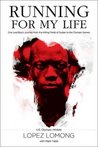 Running for My Life: One Lost Boy's Journey from the Killing Fields of Sudan to the Olympic Games by Lopez Lomong
My rating: 5 of 5 stars
I was hooked from the first sentence.
Lopepe Lopez Lomong tells his story of being torn from his mother's arms at age 6 by Sudanese rebel soldiers and taken to their camp where he surely would have perished if three teenage captives had not carried him to freedom in a daring nighttime escape. The four of them ran for their lives for three days, only to encounter soldiers at the border of Kenya who took them to a refugee camp.
Lopepe tells how he survived the camp and more, so much more. What is remarkable about him and his story is his faith and optimism. He entertains and inspires. For me this was a ten-hankie book -- but the tears I shed were because he grew my heart several sizes. In a word, he is indefatigable.
He rose above insurmountable odds, even carrying the U.S. flag in the 2008 Olympics in Beijing, China. Everything he does is for others -- to make a difference.
http://www.lopezlomong.com/
http://en.wikipedia.org/wiki/Lopez_Lo...
https://www.facebook.com/LopezLomong
http://edition.cnn.com/2012/08/06/spo...
http://edition.cnn.com/2012/08/06/spo...
This book is so good that my daughter wouldn't give it back to me so I could finish it until she had finished it. :)
 Dune Child by Ella Thorp Ellis
My rating: 3 of 5 stars
Ellis pens a fascinating first person account of growing up in an artist colony during the Great Depression of the 1930's.
 Garlic and Sapphires by Ruth Reichl
My rating: 3 of 5 stars
Ruth's account of being the restaurant reviewer for the New York Times is engaging from the very first sentence. Anyone who loves food is going to love this book. I mean, she has the gift for describing food in such a way that you want to stampede to said place and order a plate.
The challenge she has is being able to give a review of a place where she is recognized instantly and all stops are pulled to give her the best possible service and servings. Her solution? She goes in disguise.
Much of the fun of the story is hearing about the different personas she creates and how she becomes them. You enjoy all the 'supporting cast' as well.
I've never been to New York. I will probably never dine at any of these places. I am not daring in my menu choices. But I can experience this all vicariously through her account.
 The Waiting: The True Story of a Lost Child, a Lifetime of Longing, and a Miracle for a Mother Who Never Gave Up by Cathy LaGrow
My rating: 4 of 5 stars
Anyone who has or who knows someone who has given up a baby to adoption or who has adopted a child is sure to be deeply moved by Minka's story. This is a story filled with faith, forgiveness, love, perseverance, charity, determination and most of all hope.
Minka, whose story it is, was raised by her Dutch mother and German step-father. My mother, too, was raised by a Dutch mother. Reading of her upbringing elicited from me many "aha!" moments as light was shed on how affection was or was not shared in such households.
I would love to create such a personal history of my own mother's life journey. There were many times I thought I could juxtapose my mother's account into this one--certainly not Minka's details, but the time period covered very nearly mirrors my mother's.
 The Color of Water: A Black Man's Tribute to His White Mother by James McBride
My rating: 3 of 5 stars
In alternating chapters the reader/listener steps into the shoes of the eighth of twelve children and his mother.
She was the daughter of Jewish parents, raised in the south, unhappy and abused and overworked and ostrasized by her peers. Her story takes her to New York and Christianity and marriage to a remarkable man who happened also to be black. He rescued her from a downward spiral which would have ended in prostitution.
The son's story was one of confusion, searching for identity, piecing together the awakening of black pride and righting of generational wrongs.
The title is the mother's description of God. All her children received university degrees, her husband established a congregation, and she overcame the loss of two husbands.
The book is filled with understanding and hope and struggle and ultimately peace. Well worth the time spent in reading or listening.
 HAPPY TRAILS: Our Life Story by Roy Rogers
My rating: 4 of 5 stars
This iconic couple have now nearly faded completely out of memory, while in their heyday they were public favorites and even rated hero status -- right up there with Abe Lincoln and FDR.
I gained a great appreciation for both of them, especially Roy Rogers, as I read their life stories (shared in his, hers, and ours alternating chapters). It is good for someone like me who has grown up in comfort and privilege to see the price paid by the generation or two before me.
For instance, Roy's mother had polio (it was then called the "white Swelling") at the age of two and was crippled for life. She had to bend down and hold her weak leg tight around the knee for support. And yet she married and raised four children. Roy's father's brother was blind and yet he helped build a make-shift boat to transport him and Roy's family by river to carve out a life in Portsmouth, Ohio. Later the family was among the many to load all their belongings into their rickety vehicle and go to California. They found little work and much hardship there but the weather was better.
Dale Evans, who became Roy's wife, began life in Texas and became a mother herself at the tender age of 15.
Both Dale and Roy worked their way into stardom and that alone makes for a fascinating story of the studios of the day. However, as a couple they chose to adopt children and also chose to bring their own Downs Syndrome baby home rather than institutionalize her as was the practice of the day. Their story is truly inspirational. They took their roles as heroes to young people to heart and behaved both on and off set with their young enthusiasts in mind.